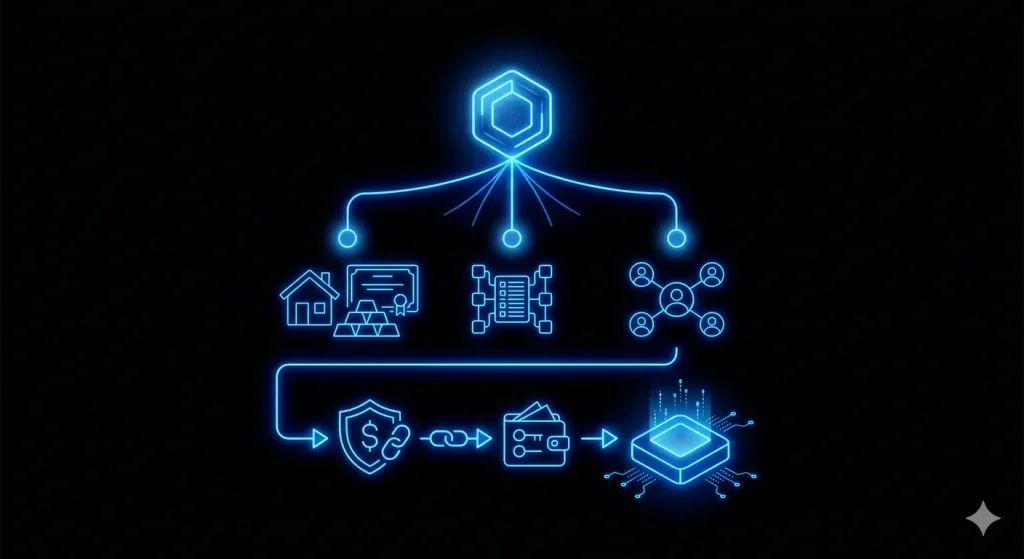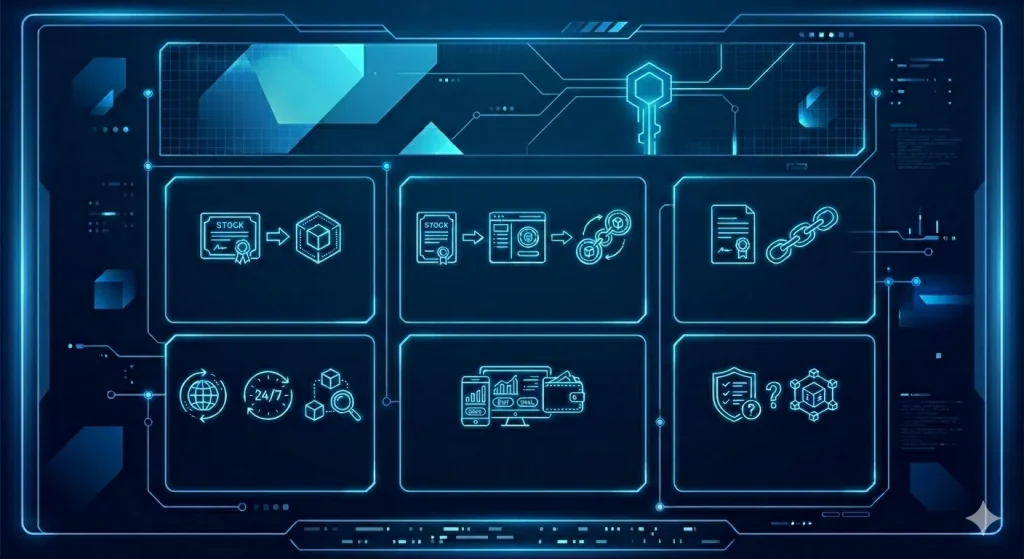
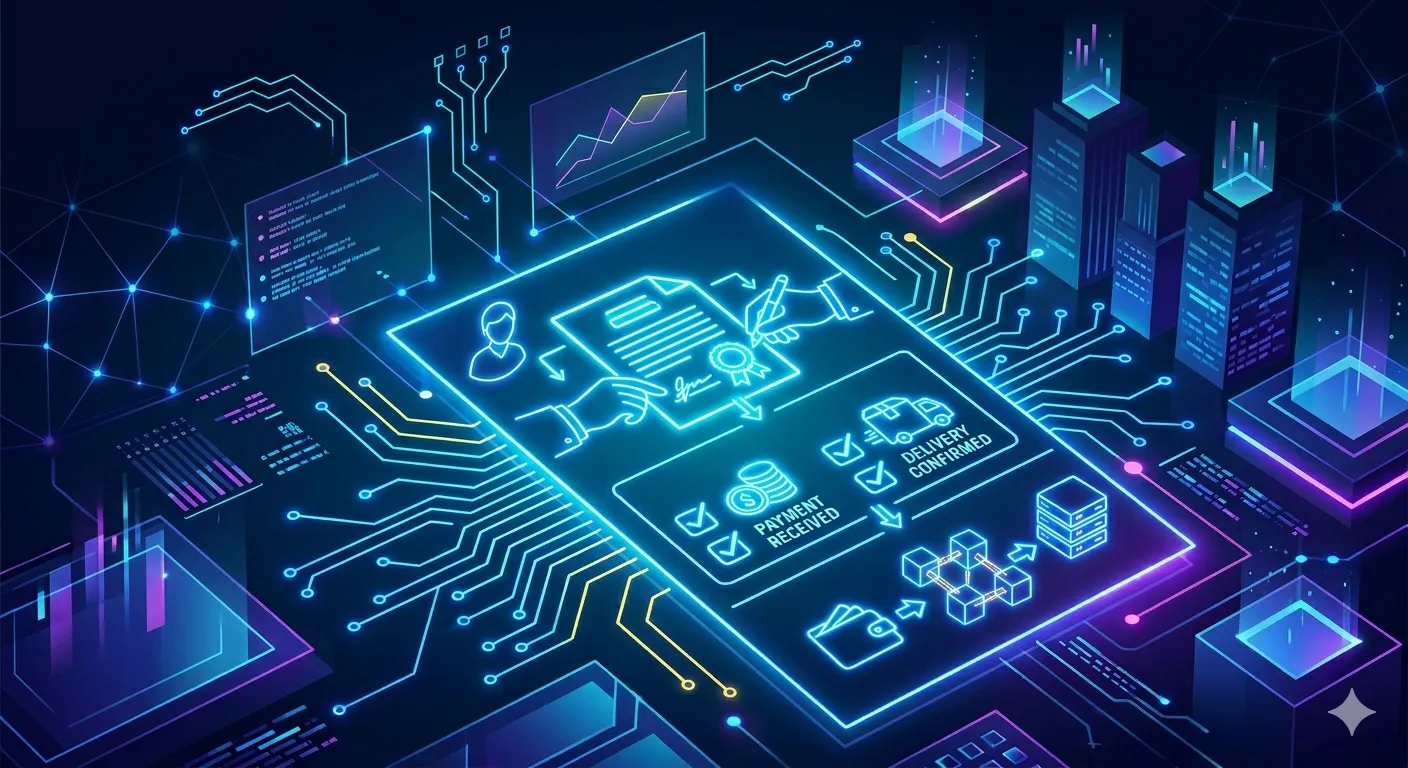
A smart contract is a self-executing agreement where the terms of the deal are written directly into lines of computer code. This code runs on a decentralised blockchain network that automatically monitors and takes action when specific predefined conditions are met.
Think of it like a digital vending machine. In a traditional contract, you would need a lawyer, an escrow agent, or a bank to ensure both sides follow through. With a smart contract, you simply “insert” the required data or digital asset (the condition), and the code automatically “dispenses” the result (the action), such as a property title or a payment, without needing a human middleman.
At Indexpo, we view smart contracts as the “operating system” for the future of global commerce. They are the essential tools that allow us to automate trust, verify real-world assets (RWAs), and create 24/7 markets that never sleep. In this guide, we’ll explore how these contracts work, their immense benefits, and the very real risks that users and developers must manage in 2026.
Disclaimer: This article is for informational purposes only and does not constitute financial, investment, or legal advice. Smart contracts and blockchain technology involve inherent risks, including code vulnerabilities and market volatility. Always do your own research and consult with a professional before making an investment or legal decision.
What Exactly Is a Smart Contract?
While the term “smart contract” might sound like futuristic AI, the concept actually predates modern blockchain. It was first coined by cryptographer Nick Szabo in 1994, who described them as digital protocols for automating transactions.
Defining the “If/Then” Logic
At its core, a smart contract operates on a simple logical flow: “If [Event A] happens, then [Action B] is triggered.”
- Self-Execution: Once the code is deployed, no one needs to “push a button” to make the contract work. It monitors the blockchain for the specific trigger.
- Determinism: A smart contract is predictable. Given the same input, it will always produce the same output across every computer (node) in the network.
Why Blockchains Are the Perfect Home
A smart contract could technically run on a private server, but it wouldn’t be “smart” in the way we use the term today. Blockchains provide three critical features:
- Decentralisation: The contract isn’t controlled by one person. It is replicated across thousands of global nodes, making it nearly impossible to shut down or censor.
- Immutability: Once the code is “on-chain,” it cannot be changed. This ensures that the terms of the deal you agreed to today are exactly the same terms that will be executed a year from now.
- Transparency: Anyone can view the contract’s code and its transaction history. This level of auditability is why platforms like Indexpo prioritise blockchain-based solutions for verifying asset ownership.
How Smart Contracts Work: The Technical Stack
To understand how a smart contract functions, one must look at the Virtual Machine environment. When a developer writes code in a high-level language like Solidity (the primary language for Ethereum and EVM-compatible chains) or Rust (favoured by high-speed networks like Solana and Near for its memory safety), it is not immediately readable by the blockchain. It must first be compiled into bytecode—a dense series of hexadecimal characters.
The Shift to Layer 2 (L2) and Rollups
By 2026, the industry will have shifted heavily toward Layer 2 Rollups (such as Arbitrum, Optimism, and ZKSync). These protocols allow complex smart contract computations to happen on a secondary layer before being “rolled up” and settled on the main ledger. This architectural shift has reduced the cost of interacting with a smart contract by up to 95%, making micro-transactions and high-frequency RWA trading economically viable (Litslink, 2026).
The Lifecycle of a Contract
- Writing the Code: Developers define the rules using logic that manages balances, ownership, and triggers.
- Deployment: The bytecode is sent to the network and assigned a unique, permanent address.
- Triggering: A user interacts with the contract or an external data source called an Oracle (a system that supplies external information to blockchains) sends a signal.
- Execution & Settlement: Network validators confirm that the conditions are met and permanently update the ledger.
Gas Fees: The Fuel for Automation
Every blockchain action uses computational energy. Users pay gas fees, which compensate validators. While Layer 2 solutions have made these fees negligible for many, network congestion on mainnets can still cause price spikes during high-demand events (IBM, 2026).
3. Key Benefits: Efficiency and Market Growth
The global smart contracts market is currently experiencing explosive growth. Analysts project the market will reach $3.95 billion by the end of 2026, growing at a compound annual growth rate (CAGR) of 23.4% (Data Insights Market, 2026).
- Automation and Efficiency: Smart contracts can reduce invoice-processing cycle times by up to 90% in industrial production environments (Mordor Intelligence, 2026).
- Accuracy and Reduced Human Error: By eliminating manual data entry, businesses reduce clerical errors. Once tested, the logic runs reliably every time.
- Trust and Disintermediation: Users rely on open-source code rather than a single company. This “trustless” environment enables global trade without the need for expensive intermediaries.
Risks: From “Code is Law” to “Ethical Reversibility”
Despite their benefits, smart contracts are not foolproof. In 2025 alone, over $3.4 billion was lost to protocol exploits (BlockEden.xyz, 2026).
The “Code is Law” Dilemma
Historically, the blockchain community lived by the mantra “Code is Law,” meaning that if a contract had a logic flaw, the resulting exploit was considered a final, valid transaction. However, in 2026, a significant movement toward Ethical Reversibility has emerged to protect institutional investors.
This involves building “Compensating Transaction” frameworks directly into the contract logic. Under this model, if a decentralised governance body (a DAO) can mathematically prove a transaction was the result of a hack, they can vote to execute a “reversal” or recovery. While purists argue this introduces a degree of centralisation, many RWA platforms tracked by Indexpo view this as a necessary “safety rail” (2Tokens, 2026).
The Oracle Risk
The “Oracle Risk” remains a critical challenge. If an oracle provides a manipulated gold price or a faulty real estate appraisal, the code will execute a “correct” action based on “incorrect” data. To mitigate this, modern protocols utilise Multi-Oracle Aggregation, requiring consensus from at least five independent data providers before a trigger is activated.
Global Regulatory Frameworks (2026 Update)
As we move through 2026, the “Wild West” era of smart contracts has been replaced by structured legal frameworks.
- The EU’s MiCA and Data Act: The European Union has created the world’s most comprehensive framework. Specifically, the Data Act now mandates that smart contracts include a “safe termination” or “kill switch” mechanism for specific enterprise use cases, balancing immutability with consumer protection.
- The UAE’s DLT Framework: In the UAE, where Indexpo monitors significant property tokenisation, the Virtual Assets Regulatory Authority (VARA) has set a global standard. Smart contracts used in real estate are now legally tethered to physical deeds through “On-chain Title Deeds.”
- The U.S. Bipartisan Stablecoin Act: This 2026 legislation provided the “settlement finality” that banks require to move billions of dollars on-chain using smart contracts (Global Legal Insights, 2026).
Use Case Deep-Dive: IoT and Infrastructure Maintenance
Beyond decentralised finance, smart contracts are revolutionizing Transport Infrastructure Maintenance. This application relies on a synergy between blockchain and Prognostics Health Monitoring (PHM) (Maciel et al., 2023).
Consider a bridge equipped with IoT sensors. In a smart-contract-governed system:
- Continuous Monitoring: Sensors send real-time structural health data to the blockchain via a decentralised oracle.
- Autonomous Triggering: If the sensor detects “material fatigue” above a safety threshold, the smart contract automatically creates a digital work order.
- Escrow & Procurement: The contract locks a payment (in stablecoins) from the budget into a secure escrow.
- Verified Performance: Once the repair is complete and verified by a secondary “digital twin” sensor, the smart contract releases the funds instantly.
This model ensures public funds are spent only when repairs are verified, reducing the administrative delays inherent in manual procurement (arXiv, 2024).
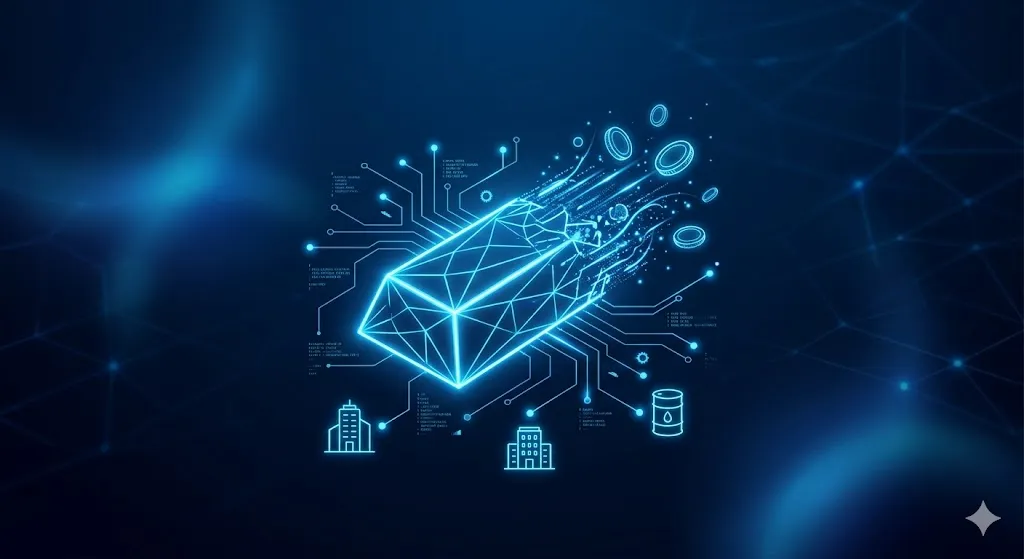
Real-World Asset (RWA) Tokenisation
At Indexpo, we track how smart contracts enable the next generation of asset management:
- Fractional Ownership: Breaking a $10M building into 10,000 digital tokens.
- Automated Compliance: Contracts that only allow ‘Whitelisted’ (pre-approved, KYC-verified) addresses to hold certain assets.
- Instant Settlement: Unlike the T+2 settlement cycle in traditional stocks, smart contracts settle trades in seconds.
The Future: Privacy, AI, and Intent-Based Execution
As we look toward 2027, the landscape is being shaped by the marriage of AI and privacy-preserving cryptography.
- Zero-Knowledge Proofs (ZKPs): ZKPs allow a user to prove they meet a requirement—such as being a “Qualified Investor”—without revealing their actual identity or balance. This is essential for the tokenised securities market we monitor at Indexpo, allowing institutions to maintain privacy while remaining compliant (Nethermind, 2025).
- AI-Orchestrated Execution: We are now seeing the rise of “Intent-Based” contracts. Instead of a user manually interacting with a contract, they express an “intent” (e.g., “Sell my tokenised gold if the price drops below $2,500”). AI agents then monitor off-chain data and interact with the smart contract at the precise moment to optimise for gas fees (Intel Market Research, 2026).
Conclusion: The Dawn of Programmable Trust and Intelligence
The transition from traditional, paper-based legal systems to the world of smart contracts represents more than just a technological upgrade; it is a fundamental shift in how global markets define and execute “trust.” As we navigate the complexities of 2026, we are witnessing the emergence of a borderless economy where human mediation is being replaced by the ironclad certainty of mathematics.
At Indexpo, our role is to serve as the critical bridge between this complex code and the strategic investor. We recognise that while “Code is Law,” the true challenge for institutional and retail participants lies in transparency and discovery. Smart contracts have successfully lowered the barrier to entry for Real-World Assets (RWAs)—from Dubai’s premium real estate to tokenised gold and carbon credits—but they have also created a vast ocean of on-chain data that requires expert interpretation.
Our mission at Indexpo is to sit at the heart of this evolution. We don’t just track asset movement; we provide the institutional-grade intelligence needed to verify the health, security, and compliance of the smart contracts governing those assets. By leveraging our on-chain analytics and discovery tools, investors can move past the hype and focus on the fundamental value of tokenised projects.
As we look toward 2027, the integration of Autonomous AI Agents with smart contract logic will further automate global finance. We are moving toward a world of “Intent-Based Markets,” where smart contracts will not only execute trades but also autonomously rebalance portfolios based on real-time yields and risk assessments. In this high-speed environment, the need for a trusted intelligence partner becomes paramount.
For the modern professional, the message is clear: the era of manual, opaque trust is ending. By embracing the efficiency and self-executing power of smart contracts, we are building a more resilient, liquid, and equitable financial future. Indexpo remains committed to being your primary discovery hub, ensuring that as the world moves toward programmable trust, you have the data and insight to lead the way.
Frequently Asked Questions (FAQ)
What is a smart contract in simple terms?
It’s a blockchain-based digital agreement that self-executes when conditions are met—like a digital vending machine.
Are smart contracts legally binding?
While local laws vary, many jurisdictions are integrating them into international trade law. Decentralised Dispute Resolution (DDR) platforms like Kleros are now used to handle cross-border disagreements on-chain (ASCE Library, 2026).
Do I need to know programming to use one?
No, most users interact via simple apps or platforms like Indexpo, with the code hidden in the background.
Can a smart contract be cancelled?
Generally, no. Most are immutable. However, some have “Pause” or “Kill” functions built in for emergencies, though this requires trusting the contract administrator.
Can a smart contract be “upgraded” if the law changes?
Yes, through Upgradeable Proxy Patterns. The user interacts with a “Proxy” address that points to the actual logic. When the law changes, the developer deploys a new logic contract and updates the Proxy to point to it. This maintains the user’s address while allowing the agreement to evolve.
How does Indexpo handle Smart Contract risk?
We use a proprietary Risk Scoring Engine that analyses the contract’s age, the volume of transactions it has handled, its audit history, and the decentralisation of its “admin keys.
Meta Title (70 characters max):
What Is a Smart Contract? 2026 Guide to RWA & Blockchain Automation
Meta Description (160 characters max):
Discover how smart contracts automate trust in 2026. Explore RWA tokenisation, IoT infrastructure maintenance, and AI-powered blockchain agreements at Indexpo.