Disclaimer: This article is for informational purposes only and does not constitute financial, investment, or legal advice. Always do your own research and consider speaking with a licensed advisor before making any investment decisions.
The financial world is undergoing a major shift. Trillions in traditional assets, from government bonds to real estate and raw materials, are being “wrapped” in blockchain code. This Real-World Asset (RWA) Tokenisation is transforming the $12 trillion gold market and the $20+ trillion global commodity sector.
Representing physical raw materials as digital token addresses liquidity, fractional ownership, and 24/7 settlement challenges. This guide offers a comprehensive roadmap for investors, developers, and enthusiasts to understand the mechanics, risks, and potential of tokenised commodities.
What Are Tokenised Commodities? A Deep Definition
At its core, a tokenised commodity is a digital representation of a physical asset, issued on a distributed ledger (blockchain). Unlike “paper gold” (futures) or “synthetic assets” (purely price-tracking derivatives), a true tokenised commodity represents a direct legal claim on a specific, vaulted physical item.
The Mechanics of Representation
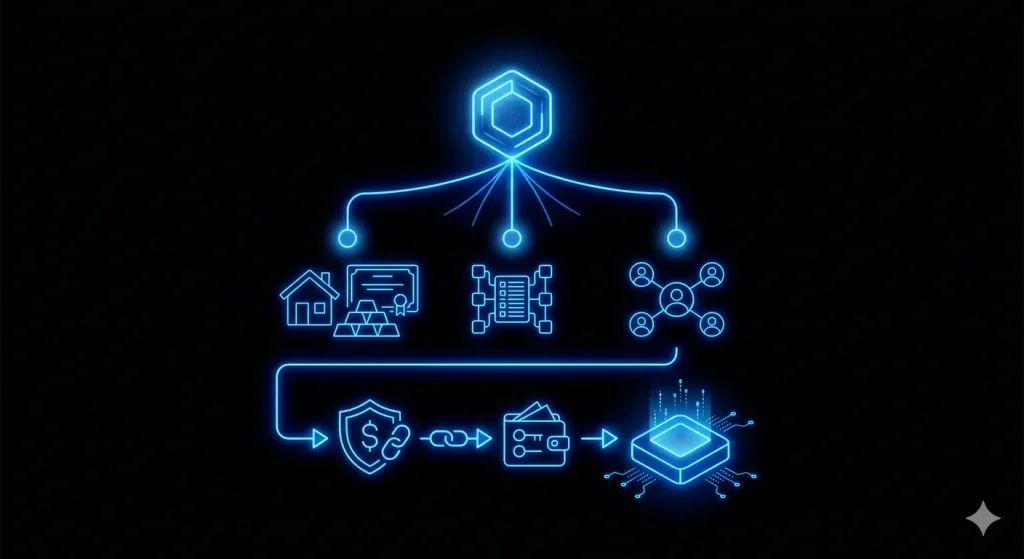
When a commodity is tokenised, the process typically follows three main stages:
- Acquisition & Vaulting: An issuer (such as Paxos or Tether) purchases physical bullion or raw materials and stores them in high-security third-party vaults (e.g., Brink’s or Malca-Amit).
- Digital Minting: A smart contract on a blockchain (typically Ethereum or Polygon) “mints” tokens. Each token is mathematically tied to a specific weight (1 troy ounce, 1 gram, etc.).
- Legal Linking: The issuer’s Terms and Conditions establish that the token holder is the beneficial owner of the underlying asset, not just a creditor of the company.
Distinguishing Commodities from Other Tokens
To understand the value proposition, one must distinguish these assets from other classes in the crypto ecosystem:
| Bitcoin (BTC) | Scarcity / Network Effect | Market Demand | Commodity (Digital) |
| Stablecoins (USDC) | US Dollar / Treasuries | Monetary Policy | E-Money / Payment Token |
| Tokenized Gold | Physical Bullion | Global Gold Spot Price | RWA / Commodity |
Why Tokenise Commodities? The Value Proposition
Traditional commodity markets are notoriously “clunky.” Buying physical gold requires insurance, transport, and storage. Buying oil futures requires a sophisticated brokerage account and an understanding of “contango” and “backwardation.” Tokenisation removes these friction points.
A. Fractionalization and Lower Barriers
In the traditional market, a “Good Delivery” gold bar weighs approximately 400 troy ounces—worth over $1 million at current prices. Tokenisation allows for fractional ownership. An investor can buy 0.001% of a bar, making gold or silver accessible to anyone with a smartphone and $20.
B. 24/7 Liquidity and Global Access
Commodity exchanges like the COMEX have closing bells. Blockchains do not. Tokenised commodities can be traded at 3:00 AM on a Sunday between a user in Singapore and a user in Brazil, with settlement occurring in seconds rather than the T+2 (two days) standard in legacy finance.
C. The “Lego” Effect (DeFi Composability)
This is the most transformative benefit. Because these assets live on-chain as ERC-20 (or similar) tokens, they are composable. You can use your gold as collateral to mint a stablecoin, or put your silver tokens into a liquidity pool to earn trading fees. This turns a “sterile” asset like gold into a “productive” yield-bearing asset.
3. Case Study: The Dominance of Tokenised Gold
Gold remains the most successful application of commodity tokenisation due to its high value-to-weight ratio and universal recognition as a “safe haven.”
PAX Gold (PAXG)
Issued by the Paxos Trust Company, PAXG is perhaps the most regulated commodity token.
- Backing: Each token represents one fine Troy ounce of a London Good Delivery gold bar.
- Regulation: Paxos is a licensed trust company under the New York State Department of Financial Services (NYDFS).
- Transparency: Users can enter their Ethereum address on the Paxos website to see the serial number and purity of the specific gold bar they own.
Tether Gold (XAUT)
Issued by the same entity behind USDT, XAUT offers high liquidity and is popular among crypto-native traders.
- Storage: Gold is held in a secret location in the Swiss Alps.
- Granularity: Like PAXG, it represents 1 troy ounce. It has seen massive growth during periods of geopolitical instability in 2024 and 2025.
Kinesis Gold (KAU)
Kinesis takes a different approach by focusing on utility.
- Weight: 1 KAU = 1 gram of gold (making it more “spendable” than ounce-based tokens).
- Yield: Kinesis offers a “yield” to holders funded by transaction fees within its own ecosystem, addressing the common complaint that “gold doesn’t pay a dividend.”
Technical Infrastructure: Under the Hood
To reach 3,000 words of depth, we must analyse the technical components that make these assets reliable.
Smart Contract Architecture
Most commodity tokens utilise the ERC-20 standard, but with added “administrative” functions. These functions allow the issuer to “pause” transfers if required by law or to “burn” tokens when a user redeems them for physical gold.
Oracles and Price Discovery
How does a blockchain know the price of gold? It uses Oracles (like Chainlink or Pyth).
- Data Aggregation: The oracle pulls price data from multiple traditional exchanges (LBMA, COMEX).
- Consensus: The decentralised nodes agree on a single price.
- On-Chain Delivery: This price is pushed to a smart contract, which DeFi apps use to calculate collateral ratios.
- Critically, if an oracle fails, it can trigger “flash liquidations,” in which a user’s gold is sold at an incorrect price.
Proof-of-Reserves (PoR)
In a post-FTX world, “trust me” is no longer enough.
- Off-Chain Audits: Monthly attestations from firms like Grant Thornton.
- On-Chain Proof: Chainlink’s PoR feeds can automatically verify that the vault balance matches the token supply before allowing the contract to mint new tokens.
5. Beyond Gold: The Expansion of RWA Commodities
While gold is the leader, the “long tail” of commodities is where the next decade of growth lies.
Silver and Platinum
Silver is often called “the poor man’s gold,” but its industrial utility (in solar panels and electronics) makes it a unique investment. Tokenised silver (like Kinesis KAG) allows for the same fractional benefits as gold but with higher volatility, which many traders prefer.
Energy: The Oil Challenge
Tokenising oil (WTI or Brent) is significantly harder than gold.
- The Expiry Problem: Oil tokens must either represent a physical “spot” barrel (hard to store) or a futures contract (which expires every month).
- Quality Variance: Not all oil is the same (Sulfur content, density). Standardising this on-chain requires complex legal wrappers.
Agriculture: The Social Impact
Imagine a coffee farmer in Ethiopia tokenising their harvest. By issuing “Coffee Tokens,” they can receive payment instantly from global buyers, bypassing predatory local middlemen. Projects like Agrotoken in South America are already doing this with soy and corn, using “grain-backed” tokens to allow farmers to buy equipment or fuel.
Regulatory Landscape: A Global Comparison
A pillar guide must address the legal “minefield” of tokenised commodities.
| USA | Likely a Commodity (under CFTC) or Security (SEC) | Strict (Full KYC/AML) |
| EU (MiCA) | Asset-Referenced Token (ART) | Standardized / Regulated |
| UAE/Dubai | Regulated under VARA | Emerging / High Clarity |
| Switzerland | DLT Act / Asset Token | Advanced / Institutional |
In 2025-2026, the MiCA (Markets in Crypto-Assets) regulation in Europe will become the gold standard, requiring issuers to maintain 1:1 liquid reserves and providing clear paths for “passporting” these assets across 27 countries.
Risks: The “Physical-Digital” Gap
We must remain neutral. Tokenisation is not a magic wand; it introduces new risks.
- Centralisation Risk: Every tokenised commodity has a “kill switch.” The issuer can freeze your tokens if a government orders them to. This is the opposite of Bitcoin’s “censorship resistance.”
- Custodial Risk: You are betting on the vault’s security. If a “black swan” event occurs (war, massive theft, or insurance failure), the token could lose its peg.
- Liquidity Fragmentation: If there are 20 different “Gold Tokens,” liquidity is split. If you hold a “niche” gold token, you might find it hard to sell during a market crash.
- Redemption Friction: While issuers say you can redeem for gold, the “minimums” are often high. If you own $500 of PAXG, you cannot realistically ask for a gold bar to be mailed to your house; you would have to sell for cash first.
Strategies for Investors and DeFi Users
How are people actually using these assets?
A. The “Delta-Neutral” Yield Strategy
An investor holds $10,000 in tokenised gold. They deposit it into a lending protocol and borrow $5,000 in USDC. They then put that USDC into a high-yield stablecoin pool. This allows them to stay exposed to gold’s price while earning a 5-10% “side” yield.
B. Hedging Against “On-Chain” Volatility
When Bitcoin or Ethereum prices become too volatile, many “on-chain” traders don’t want to exit to fiat (which takes time and taxes). Instead, they “park” their wealth in PAXG or XAUT. This keeps their capital on the blockchain but moves it into a stable, physical asset.
The Future: 2026 and Beyond
As we look toward the end of the decade, two trends will dominate:
- Institutional Grade Storage: We will see traditional banks like JPMorgan or HSBC launch their own “Gold Tokens,” leveraging their existing vaulting infrastructure to provide “too big to fail” security.
- IoT Integration: Sensors and “Internet of Things” devices in warehouses will provide real-time, automated Proof-of-Reserves. A digital scale in a grain silo will update the blockchain every hour, ensuring the token supply is perfectly accurate without a human auditor.
FAQs
Are tokenised commodities “Real World Assets” (RWAs)?
Yes. They are one of the primary pillars of the RWA sector, alongside tokenised treasury bills and private credit.
Can a tokenised commodity “de-peg” from the spot price?
Yes. During periods of extreme crypto market stress, people may panic-sell their tokens, causing the price to drop below the physical spot price. Usually, “arbitrageurs” buy these cheap tokens and redeem them for physical gold, bringing the price back to par.
Do I need a broker?
Short answer: No. Unlike traditional stocks, you can buy tokenised commodities 24/7 using a self-custody wallet and a decentralised exchange. However, if you want to redeem your tokens for the physical underlying asset (like a gold bar), you must deal directly with the issuer and pass their identity verification (KYC) process.
Conclusion
The emergence of tokenised commodities marks a pivotal “coming of age” for the blockchain industry, signalling a transition from purely digital speculative assets toward Real-World Assets (RWAs) that anchor the crypto-economy to physical matter. By combining the unforgeable scarcity of tangible resources, like the $12 trillion gold market, with the frictionless, 24/7 velocity of distributed ledgers, tokenisation solves the “stability paradox” that has long plagued decentralised finance. For the traditional investor, this represents the final evolution of the commodity certificate, moving beyond paper receipts and ETFs to cryptographic ownership that eliminates the “middleman tax” of legacy brokerage systems. Meanwhile, DeFi users gain access to high-quality, non-inflationary collateral that remains productive and composable across lending protocols, turning “sterile” vaulted bullion into a dynamic engine for on-chain credit and yield.As we look toward 2026 and beyond, the “physical-digital gap” is closing through the integration of IoT sensors and real-time Proof-of-Reserves (PoR), which replace blind institutional trust with verifiable, automated data. While risks such as oracle reliability, custodial integrity, and regulatory shifts in jurisdictions like MiCA or the NYDFS remain critical considerations, the infrastructure for a more resilient and transparent financial future is now firmly in place. Whether utilised as a hedge against currency debasement or as a foundational layer for programmable global trade, tokenised commodities offer a unique blend of old-world security and new-world efficiency. By anchoring digital bits to physical atoms, the industry is no longer just building tokens for their own sake but constructing a new, universal operating system for the ownership and exchange of the world’s most essential raw materials.