The boundary between Wall Street and distributed ledger technology is no longer a conceptual horizon; it is a functioning infrastructure. What once sounded experimental is now operational. Tokenised stocks, digital representations of publicly traded shares issued on blockchain networks, are bringing traditional equities into a programmable, on-chain environment.
For decades, equity ownership relied on centralised depositories, fixed trading hours, and multi-day settlement cycles. Today, asset tokenisation introduces an alternative framework in which ownership records can be moved across distributed ledgers, and settlement can occur more efficiently.
Tokenised stocks do not replace traditional markets. Instead, they reconfigure how access, transfer, and transparency can work in a digital financial system.
How Do Tokenised Stocks Work?
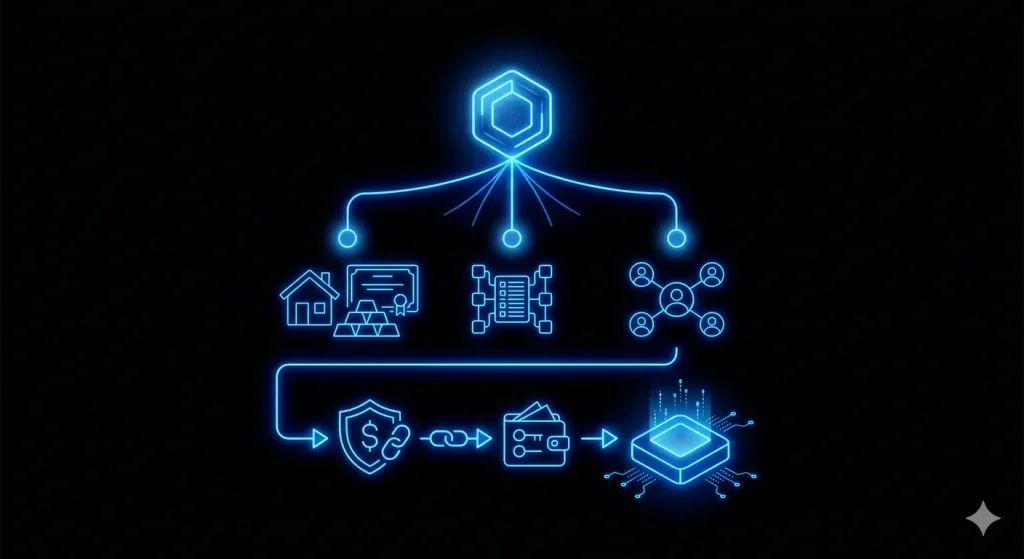
At a structural level, tokenised stocks combine traditional custody with blockchain-based issuance. The model depends on three core components: the underlying asset, distributed ledger infrastructure, and smart contract automation.
The Mechanism of the Underlying Asset
Tokenisation begins with the purchase of real shares in a public company. An issuer, typically a regulated financial entity, acquires shares (for example, Apple or Tesla) through traditional brokerage channels. These shares are then held with a qualified custodian or in a bankruptcy-remote structure.
For each share held in custody, a corresponding digital token is minted on a blockchain. This 1:1 backing differentiates tokenised stocks from synthetic derivatives that merely track price movements. In compliant structures, the token represents a legal claim tied to the underlying asset.
This model classifies tokenised stocks as security tokens, blockchain-based instruments representing regulated financial assets.
Blockchain and Distributed Ledger Technology (DLT)
Distributed Ledger Technology (DLT) acts as the record-keeping layer. Instead of relying solely on centralised databases maintained by clearing institutions such as the Depository Trust & Clearing Corporation (DTCC), ownership transfers are recorded on-chain.
This structure enables:
- Transparent ownership records
- Near-instant or atomic settlement
- Reduced reliance on reconciliation between intermediaries
Atomic settlement refers to the simultaneous exchange of the asset and payment, meaning the trade is finalised instantly rather than one or two business days later. This reduces the counterparty risk typically associated with traditional T+1 or T+2 settlement cycles, in which transactions settle with a delay.
The Role of Smart Contracts
Smart contracts introduce programmability into equity ownership. These self-executing code structures can automate specific functions, including:
- Dividend distribution – Routing payments proportionally to token holders
- Corporate actions – Managing stock splits or governance processes
- Compliance enforcement – Restricting transfers to wallets that have passed KYC (Know Your Customer) verification
While traditional equities require multiple intermediaries to coordinate these processes, blockchain-based stocks can integrate portions of this lifecycle directly into their infrastructure.
Tokenised Stocks vs Traditional Stocks: What’s the Difference?
Although the economic exposure may remain similar, the operational framework differs significantly.
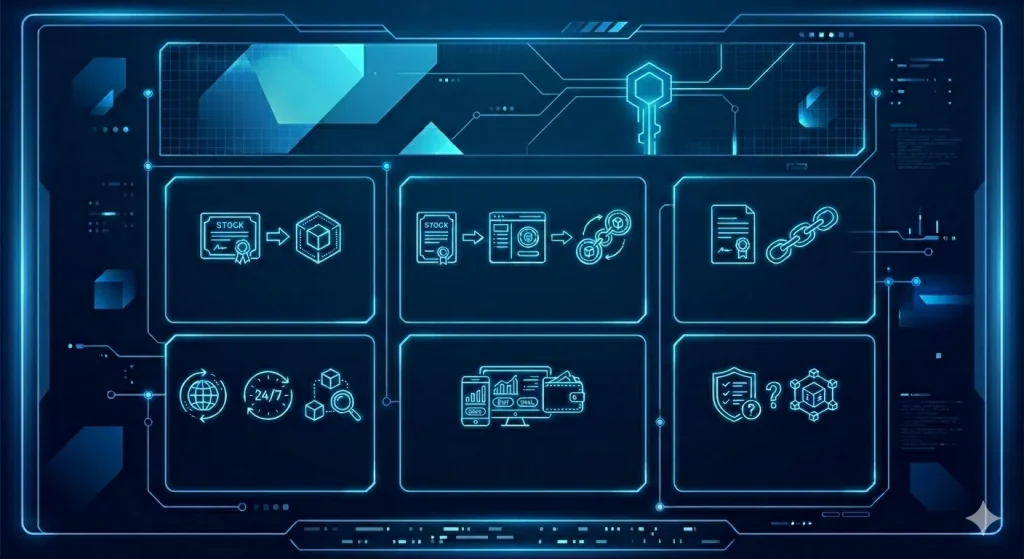
| Trading Hours | 9:30 AM – 4:00 PM (Local exchange) | 24/7/365 (platform-dependent) |
| Settlement Time | T+1 or T+2 days | Near-instant (atomic settlement) |
| Fractionalization | Broker-dependent | Native fractional ownership |
| Intermediaries | Brokers, clearinghouses, transfer agents | Smart contracts, blockchain validators |
| Transparency | Periodic reporting | On-chain verification |
The key distinction lies in infrastructure. Traditional markets rely on layered intermediaries, while tokenised models aim to streamline ownership recording and settlement.
The Key Benefits for Modern Investors
Tokenised stocks address several structural inefficiencies within legacy equity systems.
Fractional Ownership
High-priced shares such as Berkshire Hathaway (Class A) or certain large-cap technology stocks can be financially out of reach for many investors. Tokenisation allows ownership to be divided into very small units.
An investor can allocate $10 or $50 into a high-value stock rather than purchasing a full share. This enables more precise portfolio construction and lowers capital barriers.
Increased Liquidity and 24/7 Access
Traditional markets operate within fixed exchange hours and are geographically segmented. Blockchain-based stocks can, in some cases, trade outside of those hours, depending on platform rules and jurisdictional constraints.
This extended access may improve liquidity by widening the pool of potential participants.
Operational Efficiency
By reducing layers of intermediaries, tokenised systems can lower administrative friction. Institutional participants may benefit from simplified reconciliation processes and more transparent audit trails.
However, these efficiencies depend heavily on regulatory alignment and issuer credibility.
The Regulatory Landscape and Risks
Tokenised stocks operate within existing securities law frameworks in most developed jurisdictions.
Legal Status and Compliance
In the United States, digital representations of equity are typically subject to oversight by the U.S. Securities and Exchange Commission (SEC). In the European Union, regulatory treatment intersects with frameworks such as the Markets in Crypto-Assets (MiCA) regulation.
Issuers must implement:
- KYC (Know Your Customer) procedures
- AML (Anti-Money Laundering) safeguards
- Custodial compliance standards
Although blockchain networks themselves may be permissionless, access to regulated equity tokens is generally permissioned.
Risk Considerations
Despite technological advantages, several risks remain:
Platform Risk
The value of a tokenised stock depends on the credibility of the issuer and custodian. If custody arrangements fail or regulatory standing weakens, the link to the underlying asset may be compromised.
Smart Contract Vulnerability
Code-based systems reduce manual error but introduce technical risk. Bugs or exploits may disrupt token functionality.
Regulatory Uncertainty
Digital asset definitions continue to evolve. Changes in classification or jurisdictional interpretation may affect tradability or legality.
Educational Disclaimer:
This article is for informational purposes only and does not constitute financial, legal, or investment advice. Investors should conduct independent due diligence before engaging with real-world asset (RWA) platforms.
The Future of Asset Tokenisation
Public equities are only one segment of a broader asset tokenisation movement. Real estate, private credit, commodities, and alternative assets are increasingly being explored for on-chain representation.
According to the Boston Consulting Group, the tokenisation of global illiquid assets could represent a $16 trillion market opportunity by 2030 (Boston Consulting Group, 2022).
The long-term vision is not speculative hype, but infrastructure modernisation. As traditional finance (TradFi) and decentralised finance (DeFi) continue to converge, tokenisation may serve as a connective layer between institutional capital and digital-native systems.
Conclusion: A Structural Shift in Equity Access
Tokenised stocks do not reinvent equity ownership. They reconfigure how it is accessed, transferred, and recorded.
By combining regulated custody with blockchain infrastructure, these instruments introduce fractional ownership, expanded accessibility, and programmable settlement into public markets.
Whether they become a dominant model or a complementary layer will depend on regulatory clarity, institutional adoption, and technological resilience. What is clear, however, is that asset tokenisation represents a meaningful step in the evolution of global capital markets.