
In 2024, the global financial community watched the UAE with cautious curiosity as it drafted the blueprints for a digital economy. Fast-forward to 2026, and the “regulatory sandbox” has been dismantled—not because the experiment failed, but because the walls could no longer contain the scale of the architecture within. Today, the walk through Dubai’s DIFC or Abu Dhabi’s Global Market (ADGM) isn’t just a tour of physical skyscrapers, but a journey through a live, high-frequency digital ledger. The transition from speculative pilots to a hardened, national financial infrastructure is complete. The UAE has effectively turned the “Internet of Value” into a utility as reliable and essential as the power grid.
The Regulatory Backbone: VARA, ADGM, and the Central Bank
The acceleration of the UAE’s digital economy is anchored by a sophisticated, “regulation-first” philosophy. While other global markets struggled with fragmented oversight, the UAE consolidated its position through three primary pillars:
- VARA (Virtual Assets Regulatory Authority): In 2025, VARA formally introduced Asset-Referenced Virtual Assets (ARVAs), a legal category that enabled tokenised RWAs to transition from bespoke approvals to a repeatable production pathway.
- ADGM (Abu Dhabi Global Market): By 2026, ADGM’s Digital Assets Framework will have become the international benchmark for Institutional-grade security, offering a common-law environment that global asset managers trust.
- Central Bank of the UAE (CBUAE): The launch of the AE Coin (the first fully licensed dirham-backed stablecoin) and the integration of the Digital Dirham have streamlined the “cash leg” of transactions, enabling Instant settlement.
In this ecosystem, compliance is a competitive advantage. The UAE’s proactive stance has contributed to a regional digital economy projected to reach $100 billion by 2028 (Fintech News UAE, 2025).
Real-World Assets (RWA): The Engine of Growth
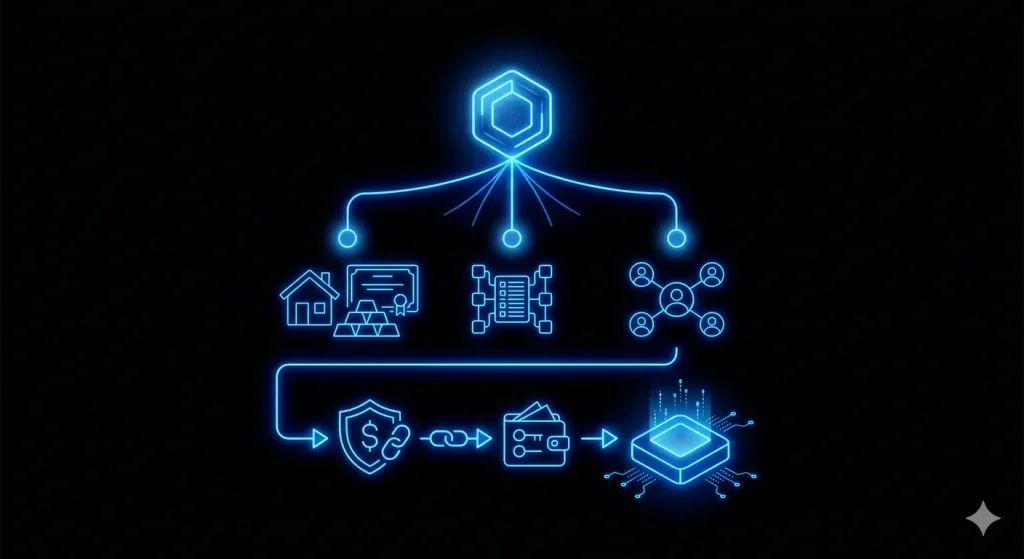
The “killer app” for blockchain in the Emirates isn’t found in a digital wallet, but in the physical skyline. Real-World Asset (RWA) Tokenisation has become the primary driver of market liquidity:
Case Study: The Prypco Mint & DLD Initiative
In May 2025, the Dubai Land Department (DLD) launched a pilot phase for the Real Estate Tokenisation Project. In collaboration with Prypco and Ctrl Alt, the project utilises the XRP Ledger to record land title deeds directly on-chain.
- The Result: A Business Bay apartment valued at AED 2.4 million was fully subscribed within 24 hours by 224 investors from 40+ nationalities (Invest-Gate, 2025).
- The Vision: DLD projects that tokenised transactions will account for 7% of Dubai’s real estate market by 2033, reaching a value of AED 60 billion ($16 billion).
Case Study: Laser Digital (Nomura Group)
In October 2025, VARA granted in-principle approval to Laser Digital to tokenise its flagship Laser Carry Fund. This marked a shift toward Institutional-grade fund tokenisation, allowing global allocators to access diversified returns through a regulated digital wrapper.
Infrastructure Readiness: Beyond the Pilot Phase
The shift to “Full-Scale Production” required a technology stack capable of handling institutional volume. The UAE has moved toward Enterprise-grade blockchains that prioritise privacy and regulatory “hooks.”
- Institutional Networks: Platforms like Polymesh are utilised to ensure that every tokenised asset carries its own compliance metadata, fulfilling VARA’s “issuance-first” logic.
- Commodity Evolution: The Dubai Multi Commodities Centre (DMCC) and VARA formalised a partnership in late 2025 to advance gold tokenisation. As the world’s second-largest gold marketplace, Dubai now facilitates on-chain trading backed by physical vaulting in the DMCC (Kearney, 2026).
For those looking to explore the technical underpinnings of these deployments, Indexpo Platforms offers a comprehensive overview of the digital infrastructure currently supporting these trades.
Institutional Adoption: Why 2026 is the Turning Point
We have moved past the era of retail speculation. In 2026, the dominant players on the ledger are sovereign wealth funds and commercial banks.
- Tokenised Deposits: Major UAE banks are now utilising tokenised deposits for real-time institutional settlement and programmable commercial payments, replacing traditional slow-moving settlement rails.
- Sovereign Wealth Integration: Groups like Ubiquium are launching Sovereign Wealth IP Programmes in early 2026, targeting the tokenisation of over £2 billion in RWAs across sectors like sports, media, and tech (Ubiquium, 2025).
“The UAE now ranks third in digital asset transaction volume in the MENA region, with $34 billion recorded in 2024 and a 30% adoption rate among the business community” (PwC & Fuze, 2025).
Challenges Overcome: The 2025 Milestones
The road to production was paved by solving critical friction points:
- Tax Clarity: In June 2025, the UAE updated its VAT law to explicitly include the transfer and management of virtual assets under financial services, removing years of fiscal uncertainty (Tax Adepts, 2026).
- Staking Frameworks: ADGM’s FSRA finalised rules for Virtual Asset Staking in late 2025, allowing authorised persons to offer yield-generating activities within a formal regulatory perimeter.
Conclusion: The UAE as the Global Benchmark
The UAE has successfully inverted the traditional financial model. While the West continues to debate definitions, the Emirates has built a production-ready engine that is currently moving billions in value every quarter. By 2026, the question is no longer if an asset should be tokenised, but how fast it can be brought on-chain.
For institutional investors and founders, the message is clear: the infrastructure is live, the regulations are settled, and the liquidity is waiting. The UAE is no longer just a participant in the digital asset race; it is the finish line.