The $2.3 trillion crypto market of March 2026 is no longer defined by speculative volatility, but by the steady, high-fidelity pulse of institutional integration. We have entered the era of the Programmable Balance Sheet, where the mechanical hurdle of moving assets on-chain has been replaced by the need for secondary-market mobility. As of this month, on-chain U.S. Treasury debt has surpassed $10.7 billion (RWA.xyz, 2026), and the number of total RWA holders has increased to around 540,000. We are no longer “bridging” two worlds; we are witnessing their total synchronisation.
This maturation represents a transition from “minted” assets to “mobile” capital. While conservative forecasts from the early 2020s projected a $16 trillion tokenised market by 2030 (BCG, 2022), the rapid expansion of BlackRock’s BUIDL fund, now exceeding $2.2 billion in assets, suggests the tipping point has arrived earlier than anticipated. The protocols leading the charge today are no longer those promising a revolution, but those providing the transparency, compliance, and liquidity infrastructure required for global economic participation.
Why RWA is the Leading Narrative in 2024-2025
Institutional players are accelerating RWA adoption. Major firms like BlackRock and JPMorgan are exploring on-chain representations of treasuries and other real-world assets, signalling confidence in their utility.
Key benefits include:
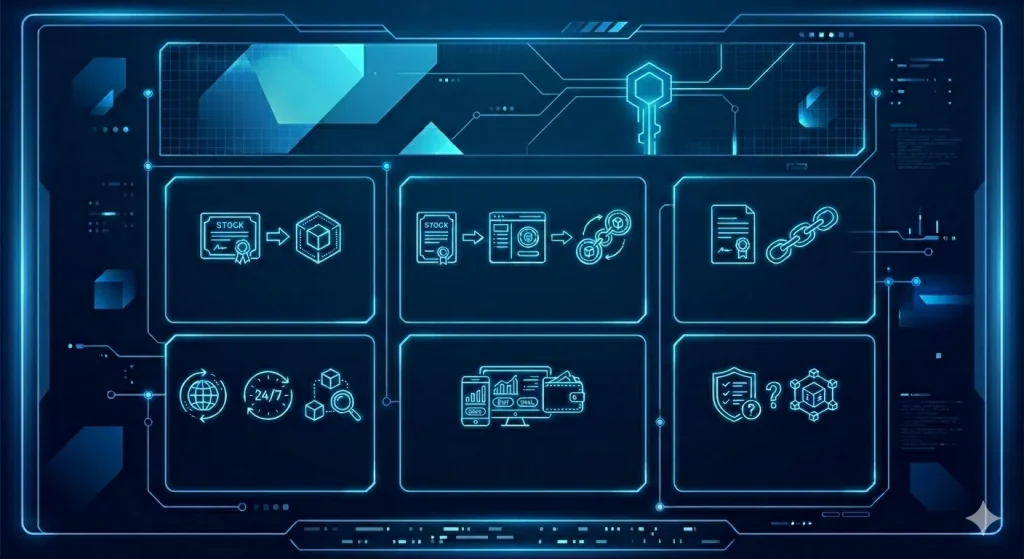
- 24/7 liquidity: Markets are no longer confined to fixed trading hours.
- Fractional ownership: Investors can access high-value assets with smaller allocations.
- Transparency: Proof of Reserves (PoR) and on-chain records reduce information asymmetry.
RWAs are not a speculative fad; they are the plumbing for the next-generation financial ecosystem.
Categorising the RWA Ecosystem
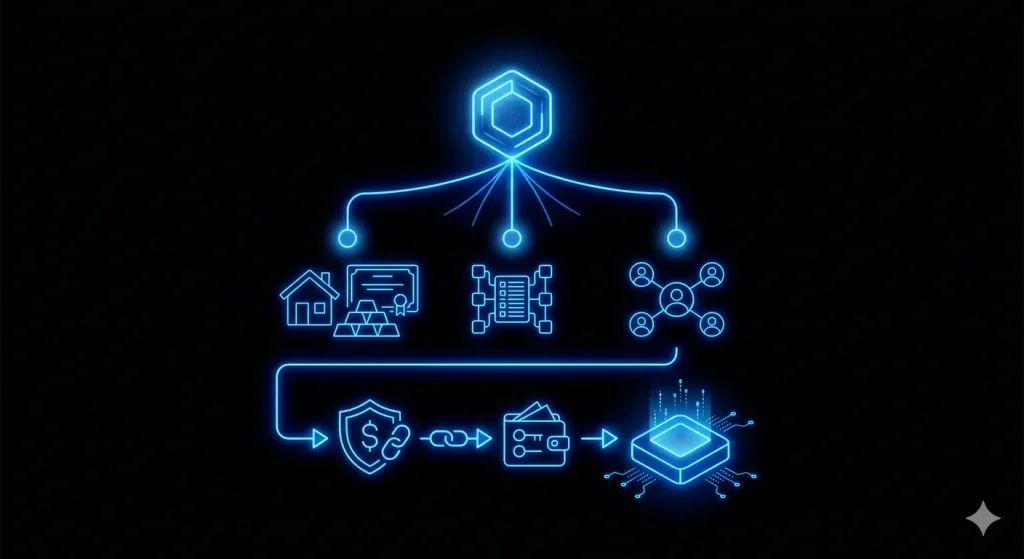
RWAs cover a range of asset classes:
- Government Bonds & Treasuries: Low-risk, yield-bearing, and now accessible on-chain.
- Private Credit: Tokenised loans and invoices enabling businesses to tap DeFi liquidity.
- Real Estate: Fractionalized property assets for passive income and portfolio diversification.
- Commodities: Gold and other precious metals represented as digital tokens.
Deep Dive: Top 10 Real-World Asset (RWA) Crypto Projects to Watch
As an intelligence layer, Indexpo tracks these protocols not as short-term tokens to trade, but as infrastructure shaping the next phase of on-chain finance. The following projects represent different segments of the RWA ecosystem, from government debt and private credit to tokenised commodities and real-world marketplaces.
1. Ondo Finance (ONDO)
Ondo remains one of the clearest examples of institutional-grade finance moving on-chain. Its focus on U.S. Treasury exposure through products such as OUSG and USDY allows investors to access short-term government-bond yield within a blockchain framework.
Market Insight:
By early 2026, Ondo will have surpassed $2.5 billion in total value locked (TVL). Its expansion into tokenised equities via xStocks and partnerships with major custodians has reinforced its position as a primary gateway to on-chain sovereign debt.
2. Centrifuge (CFG)
Centrifuge pioneered on-chain private credit, enabling businesses to tokenise real-world receivables, such as invoices, mortgages, and consumer loans, to access DeFi liquidity.
Mechanism:
The platform’s recent upgrade to Centrifuge V3, an EVM-native infrastructure, allows deeper multi-chain liquidity integration and more seamless participation from institutional lending pools.
3. MANTRA (OM)
MANTRA is an RWA-focused Layer 1 blockchain built on the Cosmos SDK. Unlike general-purpose chains, it was designed with regulatory compliance in mind.
Strategic Value:
Its “Security First” architecture includes a native KYC/AML identity module required for regulated asset transfers. With more than $1 billion in TVL in early 2026, MANTRA has positioned itself as a major hub for tokenised real estate and regulated financial assets in the Gulf region, particularly under the UAE’s VARA framework.
4. Maple Finance (SYRUP)
Maple Finance has evolved into an institutional marketplace for undercollateralized and RWA-backed lending.
2026 Update:
The protocol is targeting $100 million in Annual Recurring Revenue (ARR), largely driven by the adoption of syrupUSDC, a product that enables institutions to earn yield from U.S. Treasury-backed lending while remaining within a stablecoin framework.
5. Pendle (PENDLE)
Pendle provides a yield-tokenisation layer for DeFi and RWA-backed assets. Splitting assets into Principal Tokens (PT) and Yield Tokens (YT) allows users to separate ownership of the asset from the future yield it generates.
Utility:
By March 2026, Pendle will have become one of the primary tools for institutions seeking to lock in fixed yields on tokenised Treasury strategies or hedge against potential interest-rate cuts.
6. Clearpool (CPOOL)
Clearpool focuses on uncollateralized institutional lending, creating a marketplace that enables institutional borrowers to access liquidity directly from the DeFi ecosystem.
Growth:
The launch of Clearpool Prime, a permissioned network designed for KYC-verified lenders and borrowers, reflects the broader trend toward compliance-friendly DeFi infrastructure.
7. Polytrade (TRADE)
Polytrade operates as a marketplace layer for discovering and trading fractionalized real-world assets.
Feature:
Its RWA Marketplace aggregates tokenised assets ranging from real estate and trade finance to luxury collectables and carbon credits, helping create a unified secondary market for assets that previously existed across fragmented protocols.
8. Goldfinch (GFI)
Goldfinch focuses on expanding credit access to emerging markets without requiring crypto collateral.
2026 Status:
Through partnerships with traditional private credit funds such as Monroe Capital, Goldfinch enables DeFi liquidity providers to finance real-world businesses across Southeast Asia, Africa, and Latin America, bringing global lending markets onto the blockchain.
9. Backed Finance (bTokens)
Backed Finance issues bTokens, ERC-20 tokens that track the value of real-world securities such as equities and ETFs.
Compliance:
Operating under Switzerland’s DLT Act, each token is 1:1 backed by the corresponding asset held by regulated custodians, allowing investors to gain blockchain-based exposure to traditional financial instruments.
10. Paxos / Tether (PAXG / XAUT)
While newer protocols often dominate the conversation, tokenised gold remains one of the most established RWA categories.
2026 Data:
Combined market capitalisation of PAXG and XAUT has surpassed $6.9 billion, making tokenised precious metals a significant on-chain hedge during periods of volatility in global equity markets.
Ecosystem Perspective
Taken together, these protocols illustrate how real-world asset tokenisation is expanding across multiple financial sectors, from government bonds and commodities to credit markets and equity exposure. Rather than competing directly, many of these platforms operate as complementary layers within a broader on-chain financial infrastructure.
The Role of Regulation and Compliance
RWAs thrive on structure and legal clarity:
- Jurisdictional Leadership: UAE and Singapore lead with clear licensing frameworks; Europe is guided by MiCA.
- KYC/AML Integration: Most top-tier projects use whitelisted wallets or soulbound tokens to ensure only verified participants engage with regulated assets.
How to Evaluate an RWA Project: The Indexpo Checklist
Sophisticated participants look beyond yield dashboards:
- Underlying Asset Transparency: Is off-chain collateral verifiable via audits or Proof of Reserves?
- Custodial Risk: Who holds the assets? Are they bankruptcy-remote?
- Liquidity Depth: Can the token be sold without excessive slippage?
- Regulatory Footprint: Does the project have the required licenses in its jurisdiction?
Understanding Settlement: From T+1/T+2 to Atomic Settlement
In traditional markets, trades settle with a delay:
- T+1/T+2: “Trade date plus one or two days” means you only legally own the asset 1–2 days after execution. This delay introduces counterparty risk.
- Atomic settlement: On-chain, the exchange of assets and payment happens simultaneously, instantly finalising ownership and removing that risk.
Conclusion: Sustainability Over Speculation
RWAs are the connective tissue between decentralised finance and the broader global economy. Their value derives from real-world cash flows, interest, rent, or commodity prices, not market hype.
Protocols prioritising transparency, regulatory alignment, and institutional-grade infrastructure are shaping the backbone of a 24/7 global financial system. The focus is no longer on disrupting finance, but upgrading its infrastructure to meet the demands of a digital economy.